Hydrojetting for Cidade Líder Eateries: Pressure, Timing and Trade-Offs
It is 11 a.m. on a busy Cidade Líder avenue, and the kitchen drain is already backing up with grease from last night’s service. The lunch rush starts in sixty minutes, and every minute spent waiting for a plumber is a minute of lost covers. If you are searching for a reliable desentupidora Cidade Líder, the real question is not just who can come, but which tool they bring — because the choice between a mechanical snake and hydrojetting often decides whether the job happens before or after peak.
This is a practical guide for restaurant and shop owners on Cidade Líder’s commercial strips. It explains pressure ranges, when high-pressure washing genuinely outperforms a cable machine, and how to schedule the work around trading hours so your cash register never stops.
Why Cidade Líder’s Kitchen Drains Clog Differently
Cidade Líder is a dense commercial district, and its eateries share a common enemy: fat, oil and grease (FOG) that cools inside the lateral drain line. Unlike a residential bathroom clog, which is usually hair and soap, a restaurant line accumulates a sticky lining that narrows the pipe year after year. A 100 mm line can lose half its diameter to grease within a few months of heavy frying.
The result is a drain that drains slowly at 10 a.m. and backs up completely by 1 p.m. Many owners mistake this for a sudden blockage, but it is a progressive build-up. That distinction matters because a cable snake can punch a hole through the grease and restore flow for a week, while the lining remains and the problem returns.
Grease, scale and food solids behave differently
Three types of obstruction dominate commercial kitchens. Grease coats the pipe wall and hardens. Scale and detergent residue create a rough surface that traps more grease. Food solids — rice, coffee grounds, bits of dough — collect at low points and bends. A mechanical snake handles the third category well but struggles with the first two.
Hydrojetting Explained: Pressure Ranges and What They Do
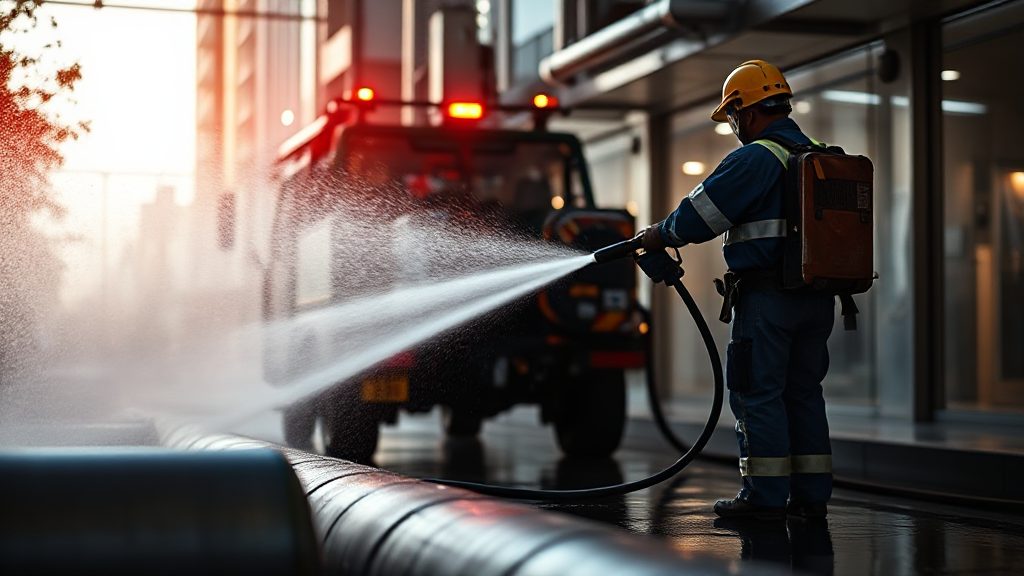
Hydrojetting uses a high-pressure water jet delivered through a flexible hose with a forward and rearward nozzle. The forward jet cuts into the blockage, while the rear jets pull the hose forward and flush debris back toward the access point. It is not just a stronger plunger; it is a wall-to-wall cleaning method.
Pressure is measured in bar or psi, and the right range depends on pipe material and condition. For typical restaurant lateral lines of 75–150 mm in cast iron or PVC, working pressures of roughly 100–200 bar are common for grease removal. Older, fragile or clay pipes require lower pressure and careful nozzle selection to avoid damage.
Flow rate matters as much as pressure
A jetting unit with high pressure but low flow can cut a channel without cleaning the walls. Flow rate, usually measured in litres per minute, determines how much debris is carried away. For commercial grease lines, a combination of moderate pressure and high flow is often more effective than maximum pressure alone.
Nozzle choice changes the result
Penetrating nozzles concentrate force on a hard blockage. Flushing nozzles use multiple rear jets to scour the full circumference. Rotating nozzles add a spinning action for stubborn scale. A technician who selects the nozzle for your specific line — rather than using one default — is a sign of a proper hydrojetting service.
When Hydrojetting Beats a Mechanical Snake
A cable snake is fast, inexpensive and ideal for a simple soft blockage or a quick emergency. But for a restaurant with recurring slow drains, hydrojetting is usually the better investment. The table below summarizes the practical differences.
| Factor | Mechanical snake | Hydrojetting |
|---|---|---|
| Grease removal | Punches a channel | Cleans the full pipe wall |
| Recurrence | Often returns in weeks | Longer-lasting result |
| Root intrusion | Cuts roots partially | Flushes loosened roots |
| Pipe condition check | Limited | Can be combined with camera inspection |
| Typical use | Quick unblock | Preventive maintenance |
If your line has been snaked three times in a year, the pattern is telling you the lining is the problem. That is the moment to ask for desentupidora Cidade Líder São Paulo SP with hydrojetting equipment, not another cable pass.
Signs you need jetting rather than snaking
- Multiple drains in the same kitchen slow down together.
- Water backs up with a greasy film and a sour smell.
- The same line clogs within a month of being snaked.
- You have a grease trap that has not been serviced recently.
Scheduling Around Trading Hours: A Practical Plan
The biggest fear for an eatery owner is closing during lunch. The good news is that most hydrojetting jobs on a lateral line take one to three hours, which means they can fit into a quiet window if planned properly. The key is to schedule maintenance before the problem becomes an emergency.
Book preventive jetting on a Monday morning or a mid-afternoon slot between lunch and dinner. Avoid Friday and Saturday evenings, when every drain in the district is under maximum load and emergency call-outs are busiest. If you must handle an active backup, ask for an after-hours or early-morning arrival so the line is clear before prep begins.
What to prepare before the technician arrives
- Clear access to the floor drain, clean-out cap and grease trap lid.
- Move boxes, mats and equipment away from the work area.
- Stop pouring grease and food scraps down drains for 24 hours before the visit.
- Inform staff which sinks must remain unused during the job.
For shops on the busiest avenues, a short maintenance contract is often cheaper than repeated emergency calls. A scheduled desentupidora em Cidade Líder São Paulo SP visit every few months keeps the line open and avoids the panic of a Friday-night flood.
Costs, Risks and the Trade-Offs That Matter
Hydrojetting costs more per visit than a simple snake, but the trade-off is frequency. A snaked line that returns every six weeks costs more over a year than a jetted line serviced twice. For a restaurant, the hidden cost of a backup — lost covers, staff overtime, ruined stock — usually dwarfs the difference in service price.
The main risk is using too much pressure on fragile pipes. Old cast iron with corrosion, clay laterals or thin PVC can crack under aggressive jetting. A responsible technician inspects the line, confirms the material and adjusts pressure accordingly. If a company quotes a single high pressure for every job without asking about your pipes, treat that as a warning sign.
Prevention beats any service call
Keep a grease trap in working order, train staff not to pour oil down sinks, and schedule jetting before the busy season rather than during it. These habits reduce the chance that you ever need an emergency visit at 11 a.m. on a lunch rush. If you run a kitchen on a Cidade Líder commercial strip, the smartest move is to plan the maintenance now — while the drains are still flowing and the register is still ringing.